Hello!
One of the topics I frequently see students for and get asked about is handwriting.
Given our digital age, it’s hard to know where handwriting fits in.
Some think handwriting is irrelevant, but I strongly disagree.
Handwriting is still very relevant, but I think the way we approach handwriting has shifted.
Let’s dive in and talk about handwriting for school age students.
Handwriting for Younger Children
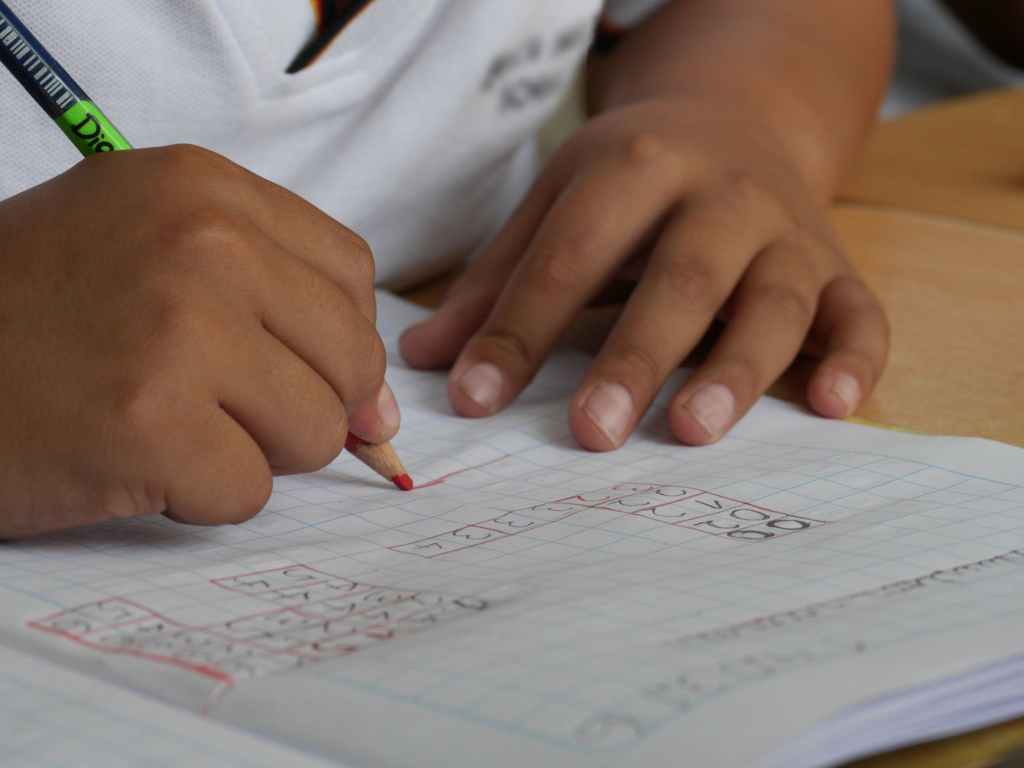
Handwriting for younger children should be all about developing the skills for handwriting.
This includes pencil grip, how to make lines, and recognizing letters.
In my opinion, handwriting skills should be taught separately from other skills so children are able to focus on one thing at a time.
Here are some tips to consider:
- Developmentally, children learn to copy horizontal and vertical lines first. So it would be only natural to start teaching children letters that are made up of these lines. Most capital letters are made up of straight lines and should be taught first. Think about letters such as H, L, T, E, F.
2. Students should be taught the proper grasp on their writing utensils. Some students will need visual instruction, some will need verbal instruction, and some will need both. Remember there are many fun ways you can promote grasp without ever touching a pencil such as arts and crafts like stringing small beads, manipulating small objects like blocks or legos, and playing board games with small pieces. Also, remember all grasps do not have to be the same! There are many different grasps that support functional handwriting.
3. Handwriting needs to be taught. A formalized handwriting program (ie: Learning Without Tears) can benefit many students. Often, young children are expected to learn the foundational skills of handwriting on their own or while learning other skills. This can be difficult for young children. Direct handwriting instruction has fallen by the wayside in many schools and it shows. Young children are often asked to write sentences including correct spelling, sentence structure, and punctuation. This is a very difficult task and isn’t in alignment with the developmental skills of young children.
Handwriting in Older Children
As children get older, handwriting problems can persist.
Teaching has moved on and the focus is on spelling, written expression, and increasing the volume of writing.
The mechanics of writing, (sizing, spacing, and baseline orientation) are no longer the focus.
If students are still struggling with the mechanics, their handwriting can suffer.
Instead of concentrating on what they want to say, they are concentrating on how to form their letters or vice versa.
When this happens, it can result in decreased legibility among other things.
Students can be capable of good handwriting mechanics, but they become secondary to written expression.
This leads to an important question.
What should be the focus for older students who are struggling with their handwriting?
I have an opinion on this (not sure if it’s popular or not) so here goes.
As a student gets older, the focus for handwriting in occupational therapy should be on function over form.
I often inherit older students with goals around grip, formation, baseline orientation, mixing capitals and lowercase letters etc, and I can’t help but wonder what’s the value of these goals?
Let me explain.
I’d like you to think about a conference room filled with 20 people all taking notes on a lecture.
Once the lecture is over, everyone hands in their notes.
If you were to look at all 20 notes, no two would be alike.
There is variety in handwriting. It is possible to have neat and legible notes even if your letter formation is not correct.
It is possible to read someone’s notes who wrote in all capital letters or who wrote in all lowercase letters, or even intermixed the two.
And it is possible to have neat and legible notes without knowing what kind of grip someone used on their pencil.
As we get older, these things matter less.
This is important to acknowledge with our students as well.
This is not to say that we ignore the foundational mechanics altogether, but that we put less emphasis on them as the student grows.
I think it’s also important when talking about handwriting to talk about habits.
Handwriting is a habit.
You learn to write between 3 and 5 (give or take).
You practice writing every day and develop both good and bad habits.
Now fast forward to being a 16-year-old junior in high school.
If you started writing at 4, that 12 years of practiced habits.
Realistically, it will take a monumental effort to change your handwriting habits at this age.
That’s why for the older student it’s important to focus on ideas and strategies as opposed to foundational mechanics learned incorrectly 12 years ago in kindergarten.
Does baseline orientation matter if you can keep your words between the lines and someone else can read it?
We need to make sure we are focusing in on a student’s functional ability to write.
What does that look like you ask?
Let’s take a look.
Functional Handwriting
I use the term “functional handwriting” a lot, but what does that mean?
I like to think of it as handwriting that will serve you as an adult.
Functional handwriting consists of things such as being able to fill in a form like a job application or sign your name when writing a check or for a credit card purchase.
Taking notes in college or during a business meeting (if you left your computer at home), or sending a card or a quick note to a friend are also considered functional handwriting.
Other important activities would be addressing an envelope, taking a phone message, writing down a phone number or the name of that new restaurant you don’t want to forget.
These are all instances where handwriting is important.
Let’s face it, we live in a digital world.
We aren’t using handwriting anymore for our 5 paragraph college essay.
Our handwriting needs as we get older are for short quick activities, and that’s what the focus needs to be on. Handwriting is a very individualistic skill, there will be differences.
We need to look at how those differences do or do not impact the outcome.
The general outcome for handwriting is a method of communication, for someone else to be able to read what we wrote.
How students write can become less important over time if the outcomes (legibility and communication) are met.
We need to make sure we are giving our students the skills in handwriting to carry them forward.
I have always loved working on handwriting with students.
It’s one of my most favorite areas to address, but our approach to handwriting especially as a student gets older needs to shift and change as the student develops.
Taking that into consideration opens so many doors to fun and creative ways to address handwriting.
The sky’s the limit!
Until next time.
P.S.-What about keyboarding you ask? Stay tuned, I’ll address keyboarding in an upcoming post!

 SuperKids Pediatric Consulting Services
4 thoughts on “Let’s Talk About Handwriting”