How to Write Effective Goals as a School-Based Occupational Therapist


Writing measurable, meaningful, and functional goals is one of the most important — and often challenging — responsibilities of a school-based occupational therapy (OT) practitioner.

Well-written goals drive intervention, guide progress monitoring, and support student success within the educational environment.

Whether you’re a new OT practitioner navigating your first Individualized Education Programs (IEPs) or a seasoned professional fine-tuning your documentation, developing strong OT goals is essential.

In this post, I’ll explore best practices, common pitfalls, and practical strategies for writing effective goals that reflect students’ unique needs while aligning with school-based outcomes.


Why Goal Writing Matters in School-Based OT

Occupational therapy services in schools are provided under the Individuals with Disabilities Education Act (IDEA).

This means every service must support a student’s access to and participation in their educational program.

Unlike clinical settings, school-based OT goals are not focused solely on rehabilitation or developmental milestones — they are educationally relevant.

A well-written OT goal:

  • Targets functional school participation
  • Aligns with classroom expectations
  • Reflects the student’s present level of performance
  • Is measurable and time-bound
  • Can be tracked to demonstrate progress

Failing to connect goals to the student’s educational performance or making them too broad can reduce the value and clarity of OT services, confuse team members, and hinder effective intervention.


The SMART Goal Formula

The gold standard for writing school-based OT goals is the SMART framework:

  • Specific: Clear, individualized, and functional
  • Measurable: Quantifiable with objective criteria
  • Attainable: Realistic for the student’s abilities
  • Relevant: Tied to academic or functional school needs
  • Time-bound: Achievable within the IEP period

Example:

In 36 weeks, with access to visual models and a pencil grip, Sam will write a five-word sentence using correct letter formation in 4 out of 5 opportunities as measured by weekly teacher observation and OT data collection.

This goal tells us what Sam will do, how support will be provided, how success will be measured, and when.


Aligning Goals with Educational Needs

When writing goals, it’s important to connect occupational performance to classroom tasks.

This ensures your services are not seen as a separate medical model but as an integrated support in the educational setting.

Functional Educational Areas to Consider:

  • Fine motor skills for writing, cutting, and manipulation
  • Visual-motor integration for copying from the board
  • Self-regulation to remain on task during academic activities
  • Sensory processing for transitions or classroom participation
  • Executive functioning for completing multi-step tasks

Avoid vague goals like “Improve fine motor skills.” Instead, identify how fine motor skills affect academic access.

Goal Example:

“Student will improve grip strength.”
“Student will complete a handwriting worksheet with appropriate grasp and legible writing for 3 consecutive days.”


Common Mistakes to Avoid

Here are some common errors new school-based OT practitioners make when writing goals — and how to fix them.

1. Too Vague or Clinical

  • “Student will increase core strength.”
  • “Student will increase core strength by sitting upright in a classroom chair for 20 minutes with no more than 1 verbal prompt in 4 out of 5 trials.”

2. Not Educationally Relevant

  • Goals must relate to school-based needs — not only developmental milestones.
  • “Student will isolate their fingers.”
  • “Student will improve their fine motor skills to access their school supplies such as notebooks, pencils and their calculator on 3/4 opportunities.”

3. No Clear Measurement

  • “Improve” and “increase” are not measurable unless paired with quantifiable data.
  • “Student will improve their fine motor skills.”
  • “Student will improve their fine motor skills for handwriting by writing a legible 3 word sentence on 3/4 opportunities.”

4. Trying to Fit Too Much

  • Each goal should focus on a single skill or functional outcome.
  • “Given a 5-minute sensory break, the student will improve their sensory processing, ability to follow directions, and reduce the number of meltdowns they have when making transitions.”
  • “Given a 5-minute sensory break, the student will improve their ability to make at least 2 transitions on 3 out of 4 trials.”

5. Writing Too Many Goals

  • Some students may have many areas of need; however, you don’t need to write goals for every single area.

    Instead, consider the overall outcome you are aiming for and base your goal on that.

Data Collection and Progress Monitoring

When you write clear goals, you make it easier to collect data and show progress. Use:

  • Rubrics for tasks like handwriting or scissor skills
  • Checklists for sensory or self-regulation routines
  • Graphs for visualizing change over time

Make sure your data collection tools match your goal’s method of measurement (e.g., observation, work samples, teacher report, etc.).


Collaborative Goal Writing

School-based OT does not happen in a vacuum. Your goals should be developed in collaboration with:

  • Teachers
  • Parents
  • Special education staff
  • The student (when appropriate)

Sample Collaborative Goal:

“With visual supports and classroom tools, Jordan will organize materials and begin independent seatwork within 2 minutes in 4 out of 5 trials as reported by the teacher over a 4-week period.”

This goal supports classroom routines and includes input from the team about what’s meaningful.


Templates and Goal Starters

Here are a few functional sentence starters to help:

  • “Given __________, student will __________ with __________ accuracy as measured by __________.”
  • “In ___ weeks, student will demonstrate __________ in ___ out of ___ opportunities.”
  • “With __________ supports, student will complete __________ with ___% independence.”

Real-Life Example: From Assessment to Goal

Present Level:

Emily is a 6-year-old in kindergarten who struggles to maintain an appropriate grasp and often avoids fine motor tasks.

She frequently scribbles and has difficulty forming letters.

Goal:

“In 36 instructional weeks, with the use of a pencil grip and OT-designed visuals, Emily will form 10 uppercase letters legibly with appropriate spacing in 4/5 opportunities, as measured by weekly classroom writing samples.”

This goal:

  • Builds from her present level
  • Addresses classroom needs
  • Incorporates supports
  • Provides a measurable outcome

Final Thoughts: Writing With Purpose

Goal writing is more than a documentation task — it’s the foundation of meaningful, school-based occupational therapy.

When your goals are SMART, functional, and educationally relevant, you:

  • Set the stage for effective intervention
  • Build strong relationships with your team
  • Advocate clearly for your role in the school system
  • Improve student outcomes

With practice and collaboration, writing great OT goals becomes second nature.


Learn about goal writing in my latest ebook The Beginner’s Guide for Occupational Therapy Practitioners.

There’s No Right or Wrong Way to Play

Play is one of the most important parts of childhood.

It’s how kids explore their world, develop new skills, and learn to express themselves.

Yet, many adults—often without realizing it—put rules or expectations on how play “should” look.

The truth is, there’s no single right or wrong way to play.

In pediatric occupational therapy, we know that play is deeply personal.

Every child engages with toys, games, and activities differently, and that’s not just okay—it’s essential for healthy development.

What Does “No Right or Wrong Way to Play” Mean?

When I say there’s no right or wrong way to play, I mean that children should be free to explore and engage with play materials in a way that feels natural to them.

For example:

A child might line up toy cars instead of racing them.

They may prefer to pretend the puzzle pieces are cookies for a tea party rather than fit them into the board.

They might choose to sit quietly with a book instead of playing tag during recess.

All of these are valid forms of play.

The goal isn’t to meet an adult’s vision of “playtime,” but to allow the child to explore, create, and interact in a way that supports their unique interests and abilities.

Why This Matters for Development

Play builds critical skills across many areas:

Motor Skills – Climbing, drawing, stacking blocks, or dancing all strengthen the body.

Cognitive Skills – Problem-solving, planning, and creative thinking happen naturally in play.

Social-Emotional Skills – Role-play, sharing, and group games help children learn to navigate relationships.

Sensory Processing – Play helps children explore textures, sounds, movement, and other sensory input in a safe way.

When we limit play to one “right” method, we risk stifling creativity and missing opportunities for skill-building in ways that feel authentic to the child.

Following the Child’s Lead

One of the best ways to support open-ended play is to follow the child’s lead.

Instead of telling them what to do with a toy, join them in their play style.

If they’re using blocks as pretend food, “cook” a meal with them.

If they’re spinning in circles, try spinning together.

This approach fosters connection and trust, encourages creativity, and demonstrates to the child that their ideas are valued.

Breaking the Myths About Play

Some adults worry that “different” play styles mean a child is playing incorrectly.

But research shows that there’s no single developmental path for play.

Neurodivergent children, for example, may engage in repetitive or sensory-focused play—and this can be deeply meaningful and regulating for them.

Instead of redirecting children to a “more typical” style of play, it’s better to observe, understand, and gently expand their play in ways that feel comfortable to them.

Final Thoughts

There’s no right or wrong way to play—only different ways to learn, grow, and express joy.

By embracing each child’s play style, we not only support their development but also nurture their self-confidence and love of learning.

At Super Kids Pediatric Consulting, we celebrate all kinds of play.

Whether your child builds castles, pretends to be a superhero, or simply enjoys lining up their favorite toys, we believe that play is play—and every style is worth celebrating.

Learn more about supporting your child’s growth at SuperKids Pediatric Consulting.

Looking for support in helping your child grow, thrive, and develop? Click here to contact me.

What Is Pediatric Occupational Therapy—and Why It Matters?

Pediatric Occupational Therapy (OT) plays a crucial role in supporting children’s development, particularly in school and community environments.

But what exactly is pediatric OT, and why should parents, teachers, and organizations care?

In this post, we’ll break down what pediatric OT is, how it helps, and why it should be a foundational part of every inclusive educational and recreational space.

What Is Pediatric Occupational Therapy? Pediatric OT helps children develop the skills they need to succeed in everyday activities or “occupations,” such as writing, playing, dressing, or participating in school.

Pediatric OTs assess and treat challenges related to motor skills, sensory processing, attention, and self-regulation.

Through targeted interventions, OTs help children become more independent, confident, and capable.

Why It Matters Children who struggle with tasks like handwriting, following routines, or tolerating noisy environments may face academic delays or social difficulties.

Pediatric OTs step in with strategies that make participation possible.

From adapting classroom tools to building sensory-friendly spaces, they work to reduce barriers and support every child’s success.

The School Connection In schools, pediatric OTs are often part of the special education team.

They provide direct therapy, collaborate with teachers, and contribute to Individualized Education Plans (IEPs).

Their work helps students stay in their least restrictive environment, ensuring equal access to learning.

OT in Community Settings Beyond the classroom, pediatric OT is expanding into businesses, including museums, movie theaters, grocery stores, and theme parks.

Consultants help design inclusive environments with sensory-friendly accommodations and quiet zones.

This means children of all abilities can enjoy outings without being overwhelmed.

Final Thoughts Pediatric OT is more than therapy—it’s a bridge to independence and inclusion.

Whether you’re a parent, teacher, or organization, understanding and supporting pediatric OT can lead to transformative outcomes for children.


Call to Action

Are you looking to create a sensory-friendly space or support in the everyday life of your student or child for your school, clinic, or business?

At SuperKids Pediatric Occupational Therapy, I specialize in developing effective sensory strategies and inclusive environments, as well as providing support for teachers, business owners, and caregivers.

Whether you need hands-on help, staff training, or developing supports, I’m here to support you every step of the way.

Contact me today to schedule a consultation, and let’s create a space where all kids can succeed, sensory needs and all.

3 Easy Sensory-Friendly Changes for Your Classroom or Business

Creating sensory-friendly spaces doesn’t have to be expensive or complicated.

Whether you’re a teacher, administrator, or business owner, a few thoughtful adjustments can go a long way in supporting individuals with sensory sensitivities.

In this post, we’ll explore three simple, effective sensory-friendly changes that can make your space more inclusive for everyone.

1. Add a Calm-Down Corner or Quiet Zone Designate a quiet, low-stimulation area with soft lighting, comfy seating, and calming visuals.

These zones are essential in classrooms, libraries, or retail stores where noise and crowds can become overwhelming.

Include sensory tools like fidgets, weighted lap pads, or noise-canceling headphones.

2. Adjust Lighting and Noise Harsh fluorescent lights and loud environments can trigger sensory overload.

Use natural light when possible or switch to soft LED bulbs.

Provide noise-dampening materials like rugs, wall panels, or acoustic ceiling tiles.

In retail or entertainment venues, consider offering sensory-friendly hours with reduced noise and lighting.

3. Use Visual Supports and Clear Signage Visual schedules, labeled areas, and communication boards help children understand expectations and transitions.

These supports are helpful in both educational and recreational settings.

They reduce anxiety and improve participation for all children.

Why It Works: These changes follow the principles of Universal Design, benefiting all users, not just those with disabilities.

By making your space more predictable and accommodating, you’re creating a more welcoming environment for everyone.

Photo by jonas mohamadi on Pexels.com

Call to Action

Are you looking to create a sensory-friendly space or design a custom toolkit for your school, clinic, or business? At SuperKids Pediatric Occupational Therapy, we specialize in developing sensory strategies and inclusive environments that actually work.

Whether you need hands-on help designing a more inclusive space, staff training, or a full sensory consultation, we’re here to support you every step of the way.

Contact me today to schedule a consultation, and let’s create a space where all kids can succeed, sensory needs and all.

Movement as a Learning Style for Kids: Unlocking the Power of the Body for the Brain

When we think of learning, we often picture a child sitting quietly at a desk, pencil in hand, eyes fixed on a worksheet or chalkboard.

But for many children, especially in the early years, this traditional model doesn’t match how their brains are wired to absorb information.

For these learners, movement isn’t a distraction—it’s the key to unlocking their full potential.

As a pediatric consultant and occupational therapist, I’ve seen firsthand how movement-based learning can transform a child’s ability to focus, understand, and retain information.

Let’s take a closer look at how movement plays a powerful role in learning and how parents, educators, and caregivers can harness it to support children’s development.

What Is Movement-Based Learning?

Movement-based learning, also known as kinesthetic learning, refers to the use of physical activity as part of the learning process.

It recognizes that some children learn best when they are actively engaging their bodies through jumping, clapping, running, dancing, stretching, or manipulating objects with their hands.

These kids are sometimes labeled as “wiggly” or “distracted,” but in reality, their movement is a natural and necessary part of how they process the world.

For them, stillness can actually hinder comprehension.

Movement-based learning taps into the body-brain connection and allows children to make sense of concepts in a way that feels intuitive and fun.

The Science Behind Movement and Learning

Movement activates many parts of the brain, including areas responsible for attention, memory, and executive function.

Studies show that physical activity increases blood flow and oxygen to the brain, which helps improve concentration and cognitive function

When children move, they are stimulating their vestibular (balance) and proprioceptive (body awareness) systems, both of which are critical for attention, spatial understanding, and motor planning.

Movement also helps strengthen neural pathways that connect the brain and body, making it easier for children to retain information.

This is especially important in early childhood, when the brain is still developing and highly responsive to sensory input.

Signs Your Child May Be a Movement-Based Learner

Every child benefits from movement, but some may need it more than others to learn effectively.

Here are a few signs your child might be a kinesthetic learner:

  1. They fidget or squirm when asked to sit still for long periods.
  2. They remember information better when it’s acted out or tied to a physical activity.
  3. They enjoy hands-on activities like building, crafting, or playing with manipulatives.
  4. They learn by doing rather than watching or listening.
  5. They are naturally athletic or physically expressive.

Recognizing your child’s learning style doesn’t mean labeling or limiting them—it means understanding how to support their growth in a way that works best for them.

Movement in the Classroom: Rethinking Traditional Models

Unfortunately, many classrooms are not designed with movement-based learners in mind.

Desks in rows, long lectures, and limited recess time can make it difficult for active learners to thrive.

But integrating movement doesn’t mean chaos.

With thoughtful planning, movement can be built into academic routines:

Brain breaks: Short movement breaks every 20–30 minutes to reset attention (think jumping jacks, yoga stretches, or a quick dance party).

Active transitions: Incorporate movement when switching tasks or subjects—march to math time, hop to reading, or stretch between lessons.

Learning through movement: Use physical games to teach academic skills (e.g., hopscotch spelling, math relay races, or letter scavenger hunts).

Flexible seating: Options like wiggle stools, floor cushions, or standing desks can allow kids to move while they work.

When movement is embedded in the day, children don’t just learn better—they feel better too.

At Home: Encouraging Movement for Learning

Parents can also support kinesthetic learning at home, especially during homework time or when teaching new skills. Here are some ideas:

  • Use sidewalk chalk to practice math or spelling outside.
  • Toss a ball back and forth while quizzing vocabulary.
  • Make learning active with scavenger hunts, obstacle courses, or role play.
  • Take learning outside for a nature walk tied to science or storytelling.
  • Play music and turn memorization into a song-and-dance routine.

Even small changes—like letting your child bounce on an exercise ball while reading—can make a big difference in focus and retention.

Movement and Emotional Regulation

Movement doesn’t just support academic learning—it’s also essential for emotional regulation.

Kids use movement to release stress, organize their thoughts, and calm their nervous systems.

That’s why so many children pace when they’re upset, bounce when they’re excited, or flop on the floor when they’re overwhelmed.

By allowing and encouraging healthy movement, we give children tools to manage their emotions and reset when their systems feel out of sync.

This is especially important for children with sensory processing differences, ADHD, or autism, for whom movement is often a crucial part of self-regulation and expression.

Debunking the Myth of “Too Wiggly to Learn”

A common misconception is that kids need to sit still to pay attention.

In reality, for many movement-based learners, stillness equals shutdown.

When we ask these children to stop moving in order to learn, we’re actually removing one of their most effective learning tools.

Instead of punishing or pathologizing movement, we need to reframe it: movement is not the enemy of learning—it is a pathway to it.

When we validate a child’s need to move and create environments that support active learning, we help them feel capable, engaged, and successful.

Embracing the Whole Child

Every child is unique, with their own rhythms, strengths, and ways of understanding the world.

For some, movement isn’t just a preference—it’s a necessity.

By embracing movement as a valid and effective learning style, we create space for all children to flourish.

Whether you’re a teacher, a parent, a therapist, or a caregiver, you have the power to honor movement-based learners.

It doesn’t require fancy equipment or major curriculum changes—just an open mind, a willingness to experiment, and a belief in the power of play.

Let’s move away from outdated expectations of stillness and start leaning into the energy and potential that comes when we let kids learn with their whole selves—body, mind, and spirit.

Call to Action

Are you raising or teaching a movement-based learner?

Start small: add a brain break into your routine, bring movement into a lesson, or offer flexible seating during homework.

You might be surprised how much more your child can focus, retain, and enjoy learning when their body gets to be part of the process.

Want more resources, games, and ideas for movement-based learning? Explore the Movement Toolkit for Kids, designed by me just for you.

Let’s keep learning moving—literally!

Photo by Anastasia Shuraeva on Pexels.com

Behind the Scenes: Creating a Sensory Toolkit

As a pediatric occupational therapist, one of the most requested resources I provide is a sensory toolkit.

These kits are designed to support regulation, attention, and participation in a variety of settings—from classrooms to theme parks.

In this post, I’ll walk you through what goes into a sensory toolkit, why it matters, and how to build one tailored to your environment.

What Is a Sensory Toolkit? A sensory toolkit is a collection of items that help individuals manage sensory input.

These tools can calm, alert, or organize the nervous system, depending on the child’s needs.

Key Items in a Sensory Toolkit:

  • Fidgets: stress balls, putty, tangles
  • Visual Aids: timers, schedules, calming visuals
  • Auditory Tools: noise-reducing headphones, white noise devices
  • Tactile Items: textured fabric, sensory brushes
  • Movement Supports: wiggle cushions, resistance bands

When and Where to Use It


Sensory toolkits are useful in:

  • Classrooms during transitions or independent work
  • Therapy sessions
  • Public outings like museums or stores

Customizing Your Toolkit

There’s no one-size-fits-all.

Consider the environment and user.

In a classroom, tools should be discreet and easy to clean. In public spaces, portability and safety are key.

Why It Makes a Difference

Sensory tools promote self-regulation and independence.

They reduce behavioral challenges and increase focus, making inclusive participation more achievable.

Building Tools That Truly Support Every Child

Creating a sensory toolkit isn’t just about collecting items—it’s about thoughtfully designing resources that foster inclusion, emotional regulation, and access to learning.

Every texture, sound, scent, or visual support included in a sensory toolkit has the potential to change the way a child experiences the world around them.

Whether used in a classroom, clinic, or community setting, these tools give children the opportunity to self-regulate, participate, and thrive in environments that might otherwise feel overwhelming.

Behind each item in your sensory toolkit should be intentional planning.

Think about the sensory needs you’re targeting, the accessibility of each item, and how it can be used flexibly.

The process of building a sensory toolkit is also a collaborative one—teachers, therapists, caregivers, and even the children themselves should be involved in shaping what works best for them.

As we continue to advocate for neurodiversity and inclusive practices, it’s essential that we give children the tools they need to succeed—not just academically, but socially, emotionally, and functionally.

Sensory toolkits are one powerful step toward achieving that goal.

Click here to download my free 1-page guide to creating a sensory toolkit!

Call to Action

Are you looking to create a sensory-friendly space or design a custom toolkit for your school, clinic, or business?

At SuperKids Pediatric Occupational Therapy, I specialize in developing sensory strategies and inclusive environments that actually work.

Whether you need hands-on help building your toolkit, staff training, or a full sensory space consultation, I’m here to support you every step of the way.

Contact me today to schedule a consultation and let’s create a space where all kids can succeed—sensory needs and all.

How to Collaborate with Teachers and Parents as a School-Based OT

Photo by Tirachard Kumtanom on Pexels.com

Strong collaboration is the backbone of effective occupational therapy in schools.

As a school-based OT, working closely with educators and families ensures that your strategies are consistent, practical, and aligned with a child’s everyday environment.

In this blog, I’ll explore the keys to successful collaboration and why it’s essential.

1. Build Trust Early. Start each school year by introducing yourself to teachers and parents.

Share your role, your contact information, and how you plan to support the student.

Being approachable and transparent lays the groundwork for future collaboration.

2. Communicate Consistently. Use regular check-ins, progress notes, or digital updates to keep everyone informed.

Don’t wait until meetings or problems arise—proactive communication ensures you’re seen as a partner, not just a provider.

3. Use Shared Language. Avoid jargon and explain strategies clearly.

When you describe sensory needs or motor delays in ways that teachers and parents understand, they’re more likely to follow through with recommendations.

Photo by Christina Morillo on Pexels.com

4. Problem Solve as a Team. Teachers and parents often notice things you may not.

Use their insights when developing intervention plans.

Collaborative problem-solving leads to better outcomes and helps everyone feel heard.

5. Respect Everyone’s Expertise. Teachers know their classroom, parents know their child, and you know OT.

Bringing these perspectives together creates well-rounded, effective support.

Why It Matters: Students thrive when adults in their lives work together.

Consistent support across home and school environments builds skills faster and leads to better carryover of strategies.

Remember, you are part of a team. Building connections helps to support each student you are working with.

Looking for more support? Click here to contact me and learn about my school-based OT practitioners mentoring program.

Why Every New School OT Needs This Beginner’s Guide

If you’re a new occupational therapy practitioner entering the school system, you’ve probably already realized there’s a steep learning curve.

Transitioning from grad school, clinical placements, or other settings into schools is a shift in both mindset and practice.

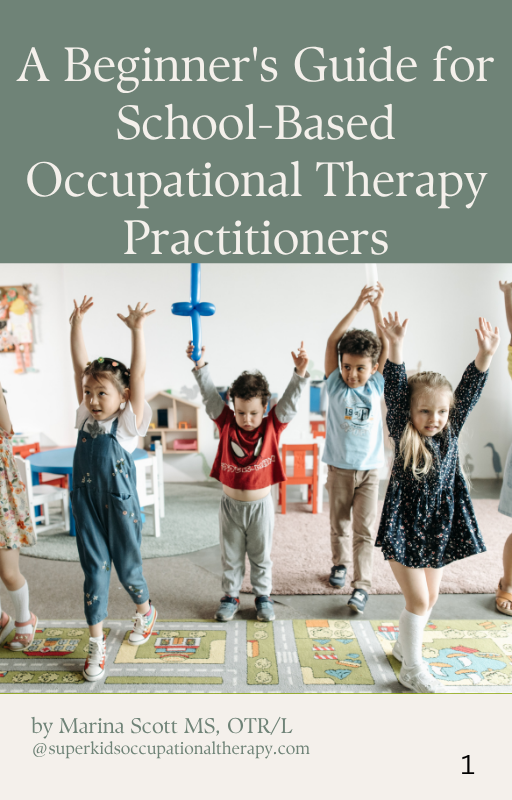
That’s why I created A Beginner’s Guide for School-Based Occupational Therapy Practitioners.

Here’s why every new school OT practitioner should grab this essential resource.

1. School-Based OT Is a Unique Niche

Working in schools is not the same as outpatient or early intervention.

This guide breaks down the key differences so you can confidently navigate your new role.

2. It’s Packed with Practical Strategies

Inside the guide, you’ll find:

  • Tips for treatment
  • IEP writing tips
  • Ways to prevent burnout
  • Resources for school-based OT practitioners

3. Created by a Practicing Pediatric OT

I’ve been in your shoes.

This guide isn’t theory; it’s based on real-world experience and tested approaches that work in actual schools and classrooms.

4. Helps You Avoid Common Pitfalls

From over-servicing to writing the wrong goals, new OTs often make avoidable mistakes.

This guide helps you sidestep them with confidence.

5. Saves You Time

Stop reinventing the wheel!

This guide offers practical tips and strategies for all aspects of school-based practice. These helpful tips will have you hitting the ground running!

6. Boosts Your Confidence

When you have a go-to resource, you feel more secure in your decisions.

You’ll feel more equipped to write strong IEP goals, explain your role to staff, and make an impact.

7. Supports Ethical, Inclusive Practice

The guide promotes evidence-based, inclusive strategies that respect diverse learners.

It helps ensure you’re practicing in alignment with school laws and OT best practices.

8. It’s Affordable and Accessible

No pricey course, no long training.

Just a straightforward, budget-friendly tool you can download and start using right away.

9. Bonus: It’s Designed With YOU in Mind

This isn’t a one-size-fits-all textbook.

It’s a user-friendly guide made for new grads, transitioning therapists, and students starting fieldwork in schools.

10. It Grows With You

Whether you’re day one or year one, this guide will grow with your needs.

You’ll come back to it again and again for inspiration, clarification, and support.

If you’re stepping into a school OT role for the first time, don’t go it alone. A Beginner’s Guide for School-Based Occupational Therapy Practitioners is your trusted companion for building confidence, staying organized, and making a meaningful difference in the lives of your students.

How to Avoid Common Mistakes New School OT Practitioners Make

Starting your career in school-based occupational therapy can be both exciting and overwhelming. While no one expects perfection, being aware of the most common missteps can help you hit the ground running. Here are some tips to help avoid common mistakes that many new school-based OTs make.

1. Understand the Educational Model

Unlike clinics, school-based OT focuses on access to the curriculum, not just skill development.

New OTs often mistakenly apply a medical model to school-based services.

Learning the IEP process, educational relevance, and least restrictive environment policies will help you better understand how to support your students effectively within an educational model.

2. Don’t Write Overly Clinical Goals

Avoid writing goals that aren’t directly tied to educational performance.

For example, instead of “improve pencil grasp strength,” try: “will write a legible sentence using appropriate pencil grasp during a classroom writing task.”

Ensure goals align with general curriculum expectations and avoid setting specific measurements or goals where the standard is 100% (since no one achieves anything 100% of the time, especially not children).

3. Don’t Try to Fix Everything

It’s tempting to address every concern, but focus on what’s functionally relevant for school participation.

Remember, functional doesn’t mean perfect.

Prioritize needs that impact access and success in the school setting.

4. Build Relationships with Teachers

Teachers are your best allies. Failing to collaborate or communicate regularly can isolate you.

Schedule check-ins, co-treat sessions, or offer strategies teachers can embed during class.

If appropriate, deliver your services in the classroom. This benefits teachers and children alike.

woman in gray shirt sitting beside girl in yellow shirt
Photo by Pavel Danilyuk on Pexels.com

5. Avoid Overbooking Yourself

It’s easy to overestimate how many students you can see in a day, especially across multiple schools.

Be realistic with your caseload and always leave room for documentation, communication, and emergencies.

Most importantly, eat your lunch and avoid taking work home. If you notice that things are piling up, speak with your administrator or supervisor before the situation gets out of control.

6. Make Sure to Begin to Collect Data From Day One

You can’t improve what you don’t measure.

Document your baseline data, session outcomes, and progress regularly.

Use simple tracking sheets, graphs, or rubrics.

7. Set Clear Boundaries

School OTs often feel pressure to “do it all.” It’s okay to say no or to clarify your role. You are not a handwriting teacher or behavior therapist—stay within your scope.

a kid writing numbers on a blackboard
Photo by Artem Podrez on Pexels.com

8. Don’t Skip Collaboration with Parents

Involve families early.

Share strategies they can use at home, and ask for input during goal setting.

Parents are a key part of student success.

9. Adapt Your Materials

Adapt your interventions to fit short windows of time, real classroom contexts, and available materials.

10. Invest in Continued Learning

Stay current on best practices.

Follow OT influencers, attend school-based OT webinars, and join groups like AOTA or your state’s OT association.

Conclusion: Being a great school-based OT isn’t about being perfect—it’s about staying curious, connected, and collaborative.

Learn from your mistakes, and always reflect on how your work impacts student access and success.

Want to learn more? Check out my website, SuperKids Occupational Therapy, or purchase my latest ebook, The Beginner’s Guide for School-Based Occupational Therapy Practitioners.

Supporting Your Child’s Nervous System and Emotional Regulation During the First Month of School

The first month of school is a big transition for children.

New routines, unfamiliar faces, and different expectations can cause stress—even for kids who seem confident and excited.

For others, the change can trigger anxiety, fatigue, or behavioral challenges.

As parents, understanding how your child’s nervous system responds to change can help you support their emotional regulation and make the adjustment smoother.

Why the Nervous System Matters During Back-to-School

Your child’s nervous system is like their personal control center.

It processes sensory information (what they see, hear, touch, smell, and taste) and influences how they feel and behave.

During the first month of school, their nervous system is working overtime to adapt to:

New sensory environments -different lighting, noise levels, smells.

Increased social interaction -classmates, teachers, playground dynamics.

More structured demands -following schedules, completing work, transitioning quickly.

When the nervous system becomes overwhelmed, your child might have trouble with emotional regulation—the ability to manage feelings and reactions in a healthy way.

This can look like meltdowns, withdrawal, irritability, or restlessness.

Common Signs of Nervous System Overload in Kids

During the first weeks of school, watch for signs that your child’s nervous system may need extra support. This can look like:

  • Trouble falling asleep or waking up frequently
  • Emotional outbursts or increased irritability
  • Complaints of headaches or stomachaches
  • Avoidance of school-related activities or conversations
  • Difficulty focusing on homework or conversations
  • Clinginess at drop-off or reluctance to go to school

Recognizing these signs early allows you to respond proactively.

Practical Ways to Support Your Child’s Nervous System

1. Prioritize Rest and Sleep

Sleep is the foundation for nervous system regulation.

During the first month of school, bedtime should be consistent, with a calming routine that might include reading, dim lights, and quiet time.

Avoid screens at least 30–60 minutes before bed, as blue light can make it harder to wind down.

2. Keep Mornings Predictable

Rushed, chaotic mornings can put the nervous system on high alert before the day even starts.

Lay out clothes the night before, pack lunches ahead of time, and keep a visual schedule to help your child know what’s next.

3. Offer Sensory Breaks After School

The school day can flood a child’s nervous system with sensory input.

Before diving into homework or activities, allow for decompression time—this could be quiet reading, a snack, a walk outside, or free play.

4. Maintain Familiar Routines at Home

While school introduces change, home can be the anchor.

Familiar routines for meals, bedtime, and family time help the nervous system feel safe and secure.

5. Provide Comfort Through Connection

Positive connection helps regulate the nervous system.

Simple gestures like hugging, sitting together during snack time, or engaging in your child’s favorite activity can reinforce a sense of safety.

Emotional Regulation Strategies for Parents to Teach Kids

The first month of school is a great time to help your child build emotional regulation skills. Here are a few strategies:

Name the feeling: “You’re feeling frustrated because the math homework is hard.”

Practice breathing techniques: Slow, deep breaths can help calm the body.

Create a quiet space: A space with soft lighting, sensory tools, and comfort items.

Model regulation yourself: Show how you handle frustration by using coping strategies out loud.

When children learn that feelings are normal and manageable, they become more confident in handling challenges.

Partnering with the School

Your child’s teachers can be powerful allies in supporting regulation during the school day.

Share any strategies that work well at home—such as movement breaks, quiet time, or sensory tools—and ask if similar supports can be provided in class.

Regular check-ins with the teacher during the first month can help identify patterns and make adjustments early.

Why Your Child’s Nervous System Matters Beyond the First Month

The nervous system adapts over time, but strong regulation habits set the tone for the entire school year.

By supporting your child now, you’re helping them:

  • Adjust to changes with less stress
  • Stay focused and engaged in learning
  • Build resilience for future challenges

When children feel balanced and supported, they can thrive academically, socially, and emotionally.

Final Thoughts

The first month of school is an adjustment for every child—but with the right support, you can help your child’s nervous system and emotional regulation stay balanced through the transition.

By combining consistent routines, sensory breaks, emotional coaching, and strong home-school communication, you give your child the tools they need to feel calm, confident, and ready to learn.

Call to Action:

As a pediatric consultant, I help parents and schools create strategies that support children’s nervous systems and emotional regulation.

Contact me today to learn how I can help your family make the back-to-school transition smoother and more successful.